Bharat’s AI Health Leap: How Technology Is Reshaping Public Healthcare
Discover how India is transforming healthcare using AI—from training 50,000 doctors to predicting disease outbreaks and improving TB detection—while preserving human empathy in medical care.Bharat’s AI Health Leap: How Technology Is Reshaping Public Healthcare
TECH AND SCIENCE
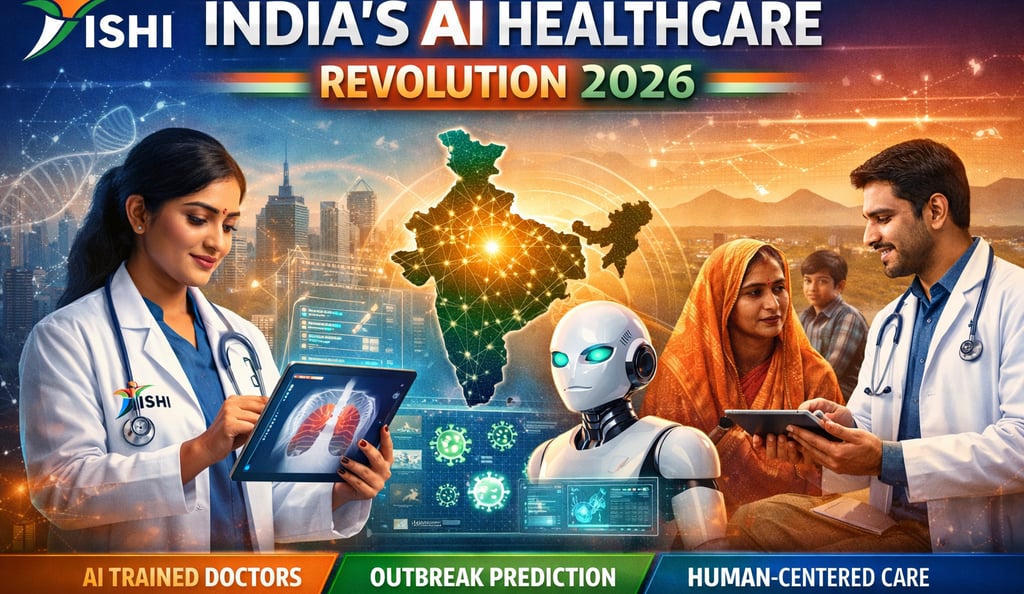
India's AI Healthcare Revolution: Doctors Get Trained, Outbreaks Predicted, and Empathy Stays Human
Hey folks, if you're into the wild world where tech meets medicine, buckle up. I'm reporting live (well, almost) from the India AI Impact Summit 2026 at Bharat Mandapam in New Delhi. It's day three, and the buzz is electric—think less "sci-fi dystopia" and more "practical game-changer" for India's massive healthcare system. Union Minister of State for Health Anupriya Patel just dropped some eye-opening updates on how AI is infiltrating everything from TB scans to zoonotic outbreak alerts. Let me break it down for you.
First off, training doctors in AI isn't some pie-in-the-sky idea anymore. The Health Ministry's online program, rolled out by the National Board of Examinations in Medical Sciences back in January, has already snagged over 42,000 doctor sign-ups. The goal? Train 50,000 docs in AI basics for diagnostics, research, and day-to-day clinical work. As Patel put it during her session "Innovation to Impact: AI as a Public Health Game-Changer," this is about making India's med pros future-proof. Imagine a rural clinic where a doctor uses AI to spot TB faster—it's happening.
Speaking of integration, AI's everywhere now. Take Health Sentinel, their AI-powered Media Scanning and Verification Cell. This beast scans news in 13 languages, crunched 300 million articles since 2022, and flagged 95,000 health events. Manual work? Down 98%. Or those handheld AI X-ray machines for TB screening—they're portable, battery-run, and boosting case detection by 16% in hard-to-reach spots. Even treatment predictions are AI-smart, slashing bad outcomes by 27%. And under the One Health Mission, ICMR's genomic tools are sniffing out animal-to-human disease jumps before they blow up. Wild, right?
But here's the smart part: they're not going full robot overlord. Dr. V.K. Paul from NITI Aayog called AI a "strategic opportunity" for universal health coverage, but stressed co-creation with real doctors and strict regs. Patel nailed it: "Healthcare thrives on human touch, empathy, compassion—stuff machines can't touch." To back that up, three AI Centres of Excellence are live at AIIMS Delhi, PGIMER Chandigarh, and AIIMS Rishikesh, blending tech with frontline care.
Key Highlights
Health Sentinel AI: Scans 13 languages, 300M+ articles, flags outbreaks—98% less manual work.[prior summit details]
TB Tools: Handheld AI X-rays detect 16% more cases; predictions cut bad outcomes 27%.
One Health AI: Predicts zoonotic jumps pre-human transmission.
Centres of Excellence: At AIIMS Delhi, PGIMER, AIIMS Rishikesh for ethical integration.
India's AI Healthcare Revolution: Doctors Get Trained, Outbreaks Predicted, and Empathy Stays Human
Hey folks, if you're into the wild world where tech meets medicine, buckle up. I'm reporting live (well, almost) from the India AI Impact Summit 2026 at Bharat Mandapam in New Delhi. It's day three, and the buzz is electric—think less "sci-fi dystopia" and more "practical game-changer" for India's massive healthcare system. Union Minister of State for Health Anupriya Patel just dropped some eye-opening updates on how AI is infiltrating everything from TB scans to zoonotic outbreak alerts. Let me break it down for you.
First off, training doctors in AI isn't some pie-in-the-sky idea anymore. The Health Ministry's online program, rolled out by the National Board of Examinations in Medical Sciences back in January, has already snagged over 42,000 doctor sign-ups. The goal? Train 50,000 docs in AI basics for diagnostics, research, and day-to-day clinical work. As Patel put it during her session "Innovation to Impact: AI as a Public Health Game-Changer," this is about making India's med pros future-proof. Imagine a rural clinic where a doctor uses AI to spot TB faster—it's happening.
Speaking of integration, AI's everywhere now. Take Health Sentinel, their AI-powered Media Scanning and Verification Cell. This beast scans news in 13 languages, crunched 300 million articles since 2022, and flagged 95,000 health events. Manual work? Down 98%. Or those handheld AI X-ray machines for TB screening—they're portable, battery-run, and boosting case detection by 16% in hard-to-reach spots. Even treatment predictions are AI-smart, slashing bad outcomes by 27%. And under the One Health Mission, ICMR's genomic tools are sniffing out animal-to-human disease jumps before they blow up. Wild, right?
But here's the smart part: they're not going full robot overlord. Dr. V.K. Paul from NITI Aayog called AI a "strategic opportunity" for universal health coverage, but stressed co-creation with real doctors and strict regs. Patel nailed it: "Healthcare thrives on human touch, empathy, compassion—stuff machines can't touch." To back that up, three AI Centres of Excellence are live at AIIMS Delhi, PGIMER Chandigarh, and AIIMS Rishikesh, blending tech with frontline care.
Key Highlights
Health Sentinel AI: Scans 13 languages, 300M+ articles, flags outbreaks—98% less manual work.[prior summit details]
TB Tools: Handheld AI X-rays detect 16% more cases; predictions cut bad outcomes 27%.
One Health AI: Predicts zoonotic jumps pre-human transmission.
Centres of Excellence: At AIIMS Delhi, PGIMER, AIIMS Rishikesh for ethical integration.