CO2 to Fuel Breakthrough: China’s Solar Tech Could Power Future Planes & Ships
Chinese scientists develop solar-powered technology to convert CO2 into fuel building blocks. A breakthrough that could reshape aviation, shipping, and clean energy future.CO2 to Fuel Breakthrough: China’s Solar Tech Could Power Future Planes & Ships
TECH AND SCIENCE
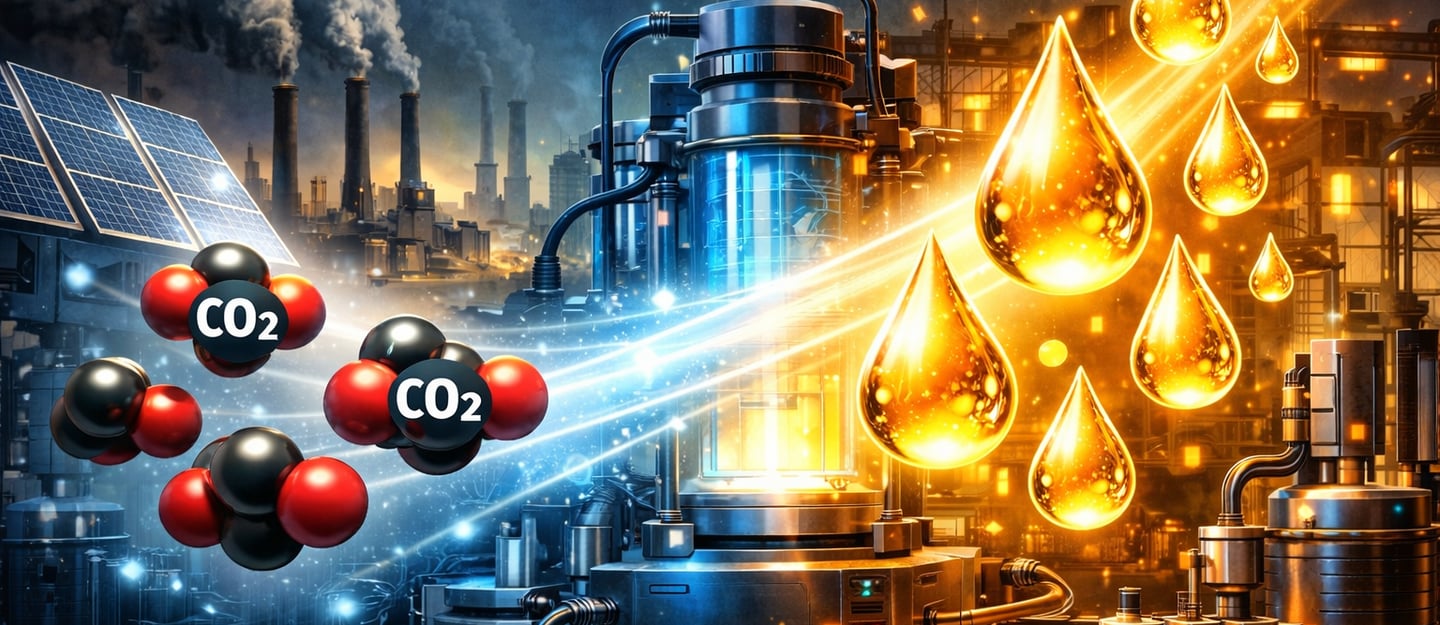
Chinese Scientists Turn CO2 into Petrol Building Blocks: A Game-Changer for Tough-to-Green Industries?
Hey folks, imagine a world where the CO2 we're pumping into the atmosphere doesn't just pile up as a climate villain—instead, it's recycled into the very fuel that powers our planes and ships. Sounds like sci-fi? Well, buckle up, because a team of Chinese researchers just made it a step closer to reality with a clever twist on artificial photosynthesis.
I'm talking about a breakthrough published last week in Nature Communications by scientists from the Chinese Academy of Sciences and the Hong Kong University of Science and Technology. They've created a solar-powered system that converts CO2 and water into carbon monoxide—the key building block for liquid fuels like petrol. No, it's not churning out gallons of gas just yet, but it's a massive leap in efficiency that could tackle those stubborn industries we've been fretting over.
How It Works (Without the Jargon Overload)
Picture this: Plants do photosynthesis like pros, using sunlight to turn CO2 and water into sugars and oxygen. These folks borrowed a page from nature's playbook, specifically a molecule called plastoquinone that acts like a tiny battery, storing electrons for later use.
They engineered silver-tweaked tungsten trioxide as their "charge reservoir." When sunlight hits it, it soaks up energy and holds onto those electrons. Pair it with the right catalysts—like cobalt phthalocyanine—and boom: CO2 gets zapped into carbon monoxide at rates 100 times faster than old-school methods. That CO can then be upgraded into hydrocarbons for jet fuel or ship diesel. Simple, elegant, and powered purely by the sun.
This isn't lab fluff either. It's building on China's real-world wins, like producing oxygen and rocket fuel from CO2 aboard the Tiangong space station. Ground control to Major Tom? More like ground control to green energy.
Why This Matters for Aviation, Shipping, and Beyond
Let's be real—switching cars to EVs is one thing, but try telling airlines and cargo ships to go fully electric. Batteries just don't pack the punch for transatlantic flights or container voyages across the Pacific. These "hard-to-abate" sectors guzzle fossil fuels and spew about 20% of global CO2 emissions.
Enter this tech. China's National Energy Administration is already pushing provinces to build sustainable aviation fuel hubs using renewables in their next five-year plan (announced late last year). If scaled up, artificial photosynthesis could turn excess solar power and captured CO2 into drop-in fuels—no need to rip apart engines or infrastructure.
It's not perfect. Efficiency is improving but still lags behind fossil fuels in cost, and scaling to industrial levels will take time and investment. Critics point out we need policy muscle—like carbon pricing—to make it competitive. But hey, this is progress that recycles our emissions rather than just burying them underground.
As someone who's covered climate tech for years, I've seen plenty of hype fizzle out. This one feels different—rooted in proven biology, backed by China's manufacturing muscle, and timed perfectly for the 2030 decarbonization crunch. Could it be the missing link in our net-zero puzzle? I'm optimistic.
What do you think—will we see CO2-powered jets by 2035? Drop your thoughts below.