India-US Trade Agreement 2026 Explained: Impact on Farmers, Politics & Economy
India-US trade deal ignites political controversy as farmers fear losses. Opposition protests, government defense, and economic impact explained. Read full analysis.
FINANCE
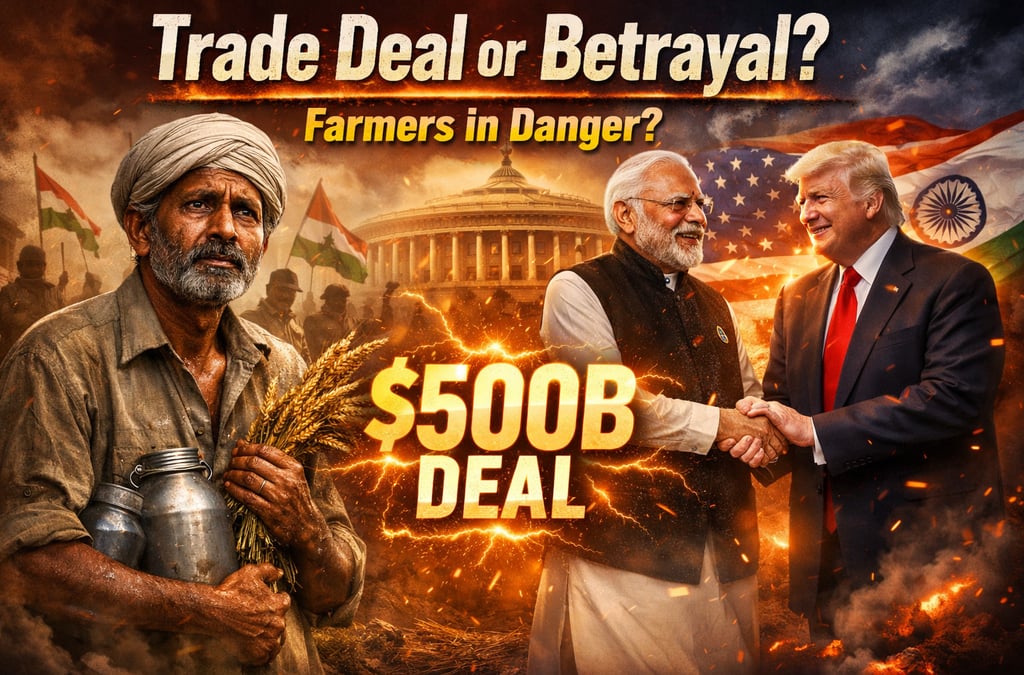
India-US Trade Deal Ignites Firestorm: Farmers' Fate Hangs in the Balance Amid Political Slugfest
New Delhi, February 4, 2026 – The ink's barely dry on the India-US trade agreement, and Parliament is already a powder keg. What started as a triumphant announcement from Washington and New Delhi has morphed into a full-blown political brawl, with opposition leaders screaming "surrender" and the government firing back that it's a "farmers-first" win. As a reporter who's covered everything from the 2020 farmer protests to Modi's trade diplomacy, I can tell you: this one's got all the makings of a national showdown.
Let's break it down. On February 2, U.S. President Donald Trump and Indian Prime Minister Narendra Modi unveiled a bilateral pact slashing U.S. tariffs on Indian goods from 25% to 18%, while India pledges to drop barriers on American products to zero over time—and commit to $500 billion in U.S. purchases. Sounds like a boon for exporters, right? Tech, energy, pharma—India's got leverage. But the real flashpoint? Agriculture.
Opposition heavyweights like Rahul Gandhi aren't mincing words. "This is surrender 2.0," Gandhi thundered outside a chaotic Lok Sabha, adjourned multiple times amid protests. Congress MP Manish Tewari zeroed in on U.S. Agriculture Secretary Brooke Rollins' gloating about flooding India's markets with American farm goods. The Samyukta Kisan Morcha (SKM), fresh off their 2021 victory lap, is calling it a "historic betrayal." They're gearing up for a week-long campaign starting today, culminating in a nationwide strike on February 12. Farmers fear cheap, subsidized U.S. imports—think corn, soybeans, dairy—will crush their livelihoods. With 140 million Indian farmers versus just 1.88 million in the U.S., the math doesn't look good.
But hold on—the government's not backing down. Commerce Minister Piyush Goyal, ever the trade warrior, insists dairy and agriculture are "red lines" untouched. "No compromise on sensitive sectors," he told reporters, slamming the opposition's "negative mindset." PM Modi echoed this in a closed-door NDA huddle, assuring allies it's all gain, no pain. Business lobbies are cheering the tariff cuts on electronics and medical devices, but skeptics point to a chilling State Bank of India report: opening dairy could cost Indian farmers ₹1.03 lakh crore annually.
What's really at stake? Transparency. The full deal text is under wraps, leaving everyone guessing. Is this Modi's masterstroke to boost exports amid global headwinds, or a capitulation to Trump's "America First" pressure? I've spoken to farmers in Punjab who remember the 2020 protests all too well—they're not buying the spin yet. Meanwhile, Wall Street's buzzing, and Indian stocks ticked up on the news.
As protests brew and Parliament reconvenes tomorrow, one thing's clear: this trade tango could redefine India's farm future. Will Modi thread the needle, or will farmers hit the streets again? Stay tuned—I'll be out here digging for answers.